



DPP-2
DPP-2, also called DPP7 or quiescent cell proline dipeptidase, is an intracellular serine protease isolated from CD26- Jurkat T cells after inhibitors of post-proline cleaving aminodipeptidases caused apoptosis in quiescent lymphocytes independent of CD26/DPPIV[1]. Mechanistically, DPP-2 cleaves N-terminal X-Pro dipeptides, and this cleavage can alter chemokines including RANTES, stroma-derived factor-1, and macrophage-derived chemokine[2]. DPP-2 supports cell-cycle quiescence because it is essential for maintaining lymphocytes and fibroblasts in G0, and its inhibition induces apoptosis through c-Myc and p53[3]. In chronic lymphocytic leukemia, DPP-2 inhibition-induced apoptosis identifies B-cell activation stage and predicts prognosis[4]. Compared with DPPIV/CD26, DPP-2 has similar substrate specificity but localizes to intracellular vesicles rather than the cell surface[2]. Compared with DPP-IV and DPP-VII, biochemical profiling defined distinct catalytic and inhibition properties among proline-specific dipeptidyl peptidases[5]. For experimental applications, a cell-permeable azabicyclo[3.3.0]octane-based DPP-2 inhibitor showed potency, selectivity, and quiescent lymphocyte death similar to less selective inhibitors[6].
References:
- [1]. Underwood R, et al. Sequence, purification, and cloning of an intracellular serine protease, quiescent cell proline dipeptidase. J Biol Chem. 1999 Nov 26;274(48):34053-8. [Content Brief]
- [2]. Chiravuri M, et al. Vesicular localization and characterization of a novel post-proline-cleaving aminodipeptidase, quiescent cell proline dipeptidase. J Immunol. 2000 Nov 15;165(10):5695-702. [Content Brief]
- [3]. Mele DA, et al. Dipeptidyl peptidase 2 is an essential survival factor in the regulation of cell quiescence. Cell Cycle. 2009 Aug;8(15):2425-34. [Content Brief]
- [4]. Danilov AV, et al. Dipeptidyl peptidase 2 apoptosis assay determines the B-cell activation stage and predicts prognosis in chronic lymphocytic leukemia. Exp Hematol. 2010 Dec;38(12):1167-77. [Content Brief]
- [5]. Leiting B, et al. Catalytic properties and inhibition of proline-specific dipeptidyl peptidases II, IV and VII. Biochem J. 2003 Apr 15;371(Pt 2):525-32. [Content Brief]
- [6]. Danilova O, et al. Synthesis and activity of a potent, specific azabicyclo[3.3.0]-octane-based DPP II inhibitor. Bioorg Med Chem Lett. 2007 Jan 15;17(2):507-10. [Content Brief]
All Product Categories
-
DPP-2 Related Products (2)
Related Products (2)

-
Puromycin aminonucleoside
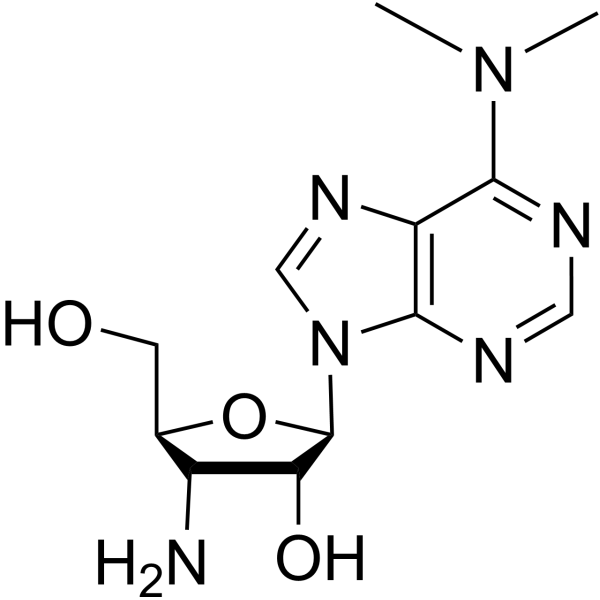 0 ImagesPuromycin aminonucleoside (NSC 3056) is the aminonucleoside portion of the antibiotic puromycin, and used in nephrosis animal models. Puromycin aminonucleoside induces apoptosis. Puromycin aminonucleoside is a reversible inhibitor of dipeptidyl peptidase II and cytosol alanyl aminopeptidase. Puromycin aminonucleoside induces secretion of cell migrasome.
-
AX8819
 0 ImagesCat. No.: HY-182374CAS No.: 928161-33-5AX8819 is a selective dipeptidyl peptidase II (DPP II) inhibitor with an IC50 of 0.88 nM. AX8819 induces caspase-dependent apoptosis. AX8819 exhibits low non-specific toxicity toward proliferating T cells. AX8819 can be used for the research of B cell chronic lymphocytic leukemia.



